NESA vs ISO 27001 vs SIA - Key Differences for UAE

Organizations operating in the UAE increasingly find themselves navigating multiple cybersecurity and compliance frameworks at the same time. What often starts as a governance initiative such as ISO 27001 certification quickly becomes more complex once national regulatory requirements like NESA and oversight by SIA enter the picture.
This complexity leads to a recurring and critical question:
“If we are already ISO 27001 certified, do we still need to comply with NESA or SIA requirements?”
The short answer is yes but the reasoning, implications, and execution are often misunderstood.
This article provides a clear, in-depth comparison of NESA, ISO 27001, and SIA, explains how they differ in purpose and enforcement, and outlines how UAE organizations should approach compliance strategically rather than reactively.
Why UAE Organizations Face Multiple Cybersecurity Frameworks
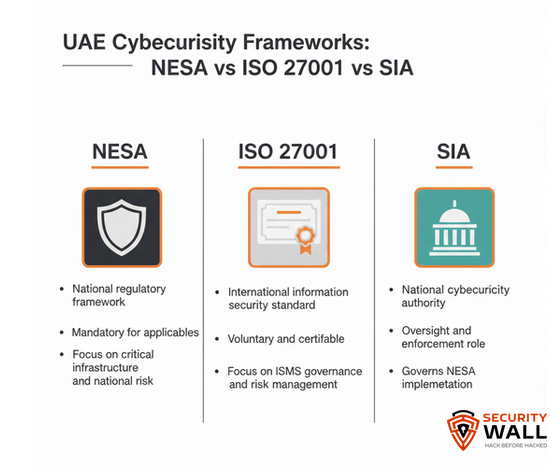
The UAE’s cybersecurity model is intentionally layered. Unlike jurisdictions that rely primarily on voluntary standards, the UAE combines international best practices with national regulatory controls designed to protect critical infrastructure, sensitive government systems, and services with national impact.
As a result, organizations may simultaneously face:
- International frameworks such as ISO 27001
- National regulatory obligations under NESA
- Oversight and enforcement through SIA
- Sector-specific requirements tied to government or critical services
This layered approach strengthens national cyber resilience—but it also means organizations must understand which frameworks are optional, which are mandatory, and how they interact.
Misinterpreting this relationship is one of the most common causes of compliance gaps in the UAE.
Understanding the Role of NESA in the UAE
NESA (National Electronic Security Authority) represents the UAE’s national cybersecurity regulatory framework, implemented through the UAE Information Assurance (IA) Regulation. It applies to government entities, semi-government organizations, critical infrastructure operators, and private entities that support regulated or nationally critical services.
NESA focuses on:
- National cyber risk and resilience
- Governance and accountability at an organizational level
- Protection of critical systems, data, and services
- Evidence-based implementation of security controls
Unlike international standards, NESA compliance is mandatory where applicable. Organizations cannot self-certify, and third-party firms cannot issue NESA compliance certificates.
For organizations still building foundational understanding, a broader explanation of NESA in the UAE helps clarify scope and applicability before moving into detailed requirements.
Understanding ISO 27001 and Its Role
ISO 27001 is an international information security management system (ISMS) standard developed to help organizations systematically manage information security risks.
It is widely adopted because it:
- Provides a structured governance framework
- Is internationally recognized
- Can be independently certified
- Supports customer, partner, and market trust
ISO 27001 focuses on how an organization manages information security rather than what specific national risks must be addressed.
Importantly, ISO 27001 is voluntary. While it demonstrates maturity and good practice, it does not override or replace regulatory requirements in the UAE.
Many UAE organizations pursue ISO 27001 first, only to later discover that regulatory frameworks like NESA impose additional, non-negotiable obligations.
Understanding SIA and Its Relationship to NESA
The Signals Intelligence Agency (SIA) is the UAE authority responsible for national cyber intelligence, cybersecurity governance, and resilience at a national level.
From an organizational perspective, it is important to understand that:
- SIA is not a compliance framework
- Organizations do not “certify” against SIA
- SIA is the authority under which NESA is governed and enforced
In practical terms, NESA operates under SIA, and official regulatory assessments or audits are conducted or mandated through this authority.
This distinction matters because many organizations mistakenly assume SIA introduces a separate compliance requirement. In reality, SIA provides oversight and enforcement, while NESA defines what organizations must implement.
NESA vs ISO 27001 vs SIA: A Practical Comparison
Understanding the differences becomes easier when comparing the frameworks across key dimensions.
| Aspect | NESA | ISO 27001 | SIA |
|---|---|---|---|
| Nature | National regulatory framework | International standard | National authority |
| Mandatory | Yes (for applicable entities) | No | Not a framework |
| Certification | No | Yes | No |
| Enforced By | National authority | Accredited certifiers | Government |
| Focus | National risk, critical infrastructure | ISMS governance | National cyber resilience |
| Evidence-Driven | Yes | Yes | Yes (via NESA) |
The key distinction is intent:
- ISO 27001 builds internal security maturity
- NESA enforces national cybersecurity obligations
- SIA ensures alignment with national security objectives
“If We Are ISO 27001 Certified, Do We Still Need NESA?”
This is the most common—and most misunderstood question among UAE organizations.
The answer depends on applicability, but in regulated contexts the answer is almost always yes.
ISO 27001:
- Demonstrates that an organization manages information security risks
- Supports governance, policy development, and risk assessment
- Provides a strong operational foundation
However, ISO 27001:
- Is not a UAE regulatory requirement
- Does not address national-level cyber risk
- Does not include sector-specific or government-mandated controls
NESA, on the other hand, is designed specifically to:
- Protect national interests
- Ensure resilience of critical services
- Enforce mandatory controls
In practice, ISO 27001 can support NESA compliance, but it cannot replace it.
Talk to a NESA expert about your compliance and risk challenges

How ISO 27001 Can Support NESA Compliance
When implemented correctly, ISO 27001 can significantly reduce the effort required for NESA compliance.
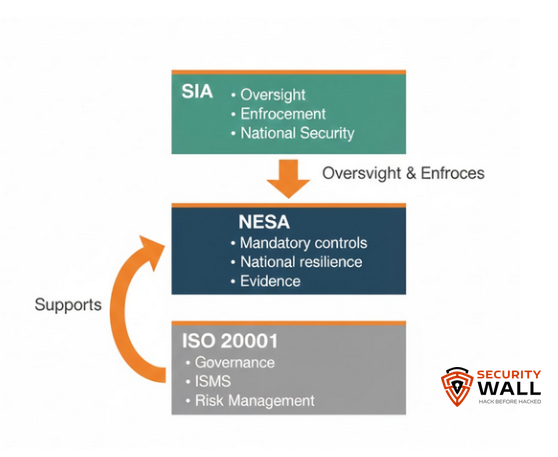
ISO 27001 helps organizations by providing:
- A structured governance model
- Defined risk assessment methodologies
- Policy and control documentation discipline
- Management review and accountability mechanisms
These elements align well with many NESA expectations. However, NESA introduces additional controls, regulatory oversight, and evidence requirements that ISO does not cover.
Organizations that attempt to rely solely on ISO certification often discover these gaps during regulatory review when remediation is more costly and time-sensitive.
The Risk of Treating Frameworks in Isolation
One of the most common mistakes UAE organizations make is treating each framework as a separate initiative.
This leads to:
- Duplicate controls and documentation
- Conflicting ownership and accountability
- Increased audit fatigue
- Higher compliance costs
A more effective approach is to align ISO-based ISMS programs with NESA requirements as part of a unified governance and risk framework.
This is where structured NESA compliance services become critical, helping organizations map controls, normalize evidence, and avoid duplication.
Choosing the Right Compliance Approach for Your Organization
There is no one-size-fits-all approach, but there are clear strategic principles.
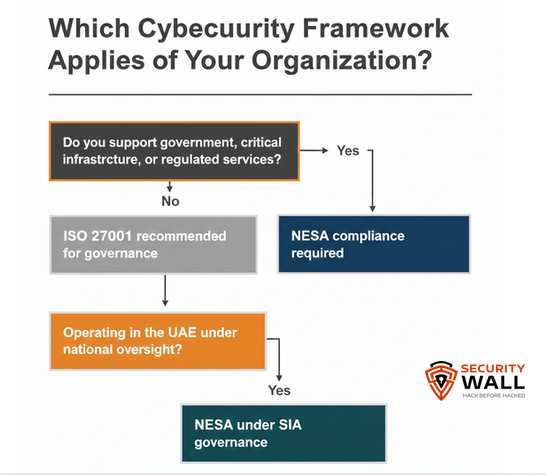
Organizations That Benefit Most from ISO 27001
- Private companies with international customers
- Organizations seeking global credibility
- Businesses focused on information security governance
Organizations That Must Prioritize NESA
- Government and semi-government entities
- Critical infrastructure operators
- Organizations supporting regulated or nationally critical services
Organizations That Need Both
Many UAE organizations fall into this category. For them, the goal should be integration, not replacement.
A unified compliance strategy aligned with enterprise cybersecurity and compliance services reduces risk, cost, and operational disruption.
Enforcement, Audits, and Accountability: A Key Difference
Another major distinction lies in how compliance is assessed and enforced.
- ISO 27001 audits are conducted by accredited certification bodies
- NESA assessments are regulatory evaluations conducted or mandated by national authorities
- Organizations cannot self-certify NESA compliance
This difference changes how organizations should prepare. Regulatory assessments focus heavily on evidence quality, governance maturity, and national risk impact, not just control presence.
Understanding these differences early prevents unpleasant surprises later.
A Strategic Perspective for UAE Leadership
For executive teams, the real question is not which framework is “better,” but how to manage compliance risk intelligently.
ISO 27001 answers:
- “Do we manage information security effectively?”
NESA answers:
- “Are we meeting national cybersecurity obligations?”
SIA ensures:
- “Are these obligations enforced in line with national security priorities?”
Treating these as complementary rather than competing frameworks allows organizations to:
- Build resilience
- Reduce regulatory exposure
- Avoid reactive compliance
NESA, ISO 27001, and SIA are not interchangeable. They exist for different reasons, serve different stakeholders, and carry different consequences.
For UAE organizations:
- ISO 27001 builds maturity
- NESA enforces national security requirements
- SIA governs and oversees enforcement
The organizations that succeed are those that align frameworks strategically, rather than chasing certifications or reacting to audits.
If your organization operates in a regulated or high-impact environment, the safest path forward is to treat NESA compliance as a core requirement supported, not replaced, by ISO-based governance.
Related Reading
- Understand the scope, applicability, and regulatory mandate of NESA by starting with our overview of NESA in the UAE.
- Explore the specific domains, controls, and documentation requirements that differentiate NESA from other frameworks in our guide to NESA compliance requirements.
- Prepare your organization practically for compliance and assessments using our NESA compliance checklist.
- Learn how audits are conducted and what assessors evaluate by reviewing our explanation of the NESA audit and assessment process.
- If you need expert guidance to implement, align, or audit against NESA and related frameworks, explore our NESA compliance services.
- View how NESA fits into broader regulatory and cybersecurity obligations through our compliance solutions.
Frequently Asked Questions (FAQs)
Is ISO 27001 mandatory in the UAE?
No. ISO 27001 is voluntary, though widely adopted.
Is NESA mandatory for all organizations?
No. NESA applies to specific entities and services, but where applicable it is mandatory.
Can ISO 27001 certification be used as proof of NESA compliance?
No. It can support readiness but does not replace regulatory assessment.
Does SIA replace NESA?
No. NESA operates under SIA, which provides oversight and enforcement.
If your organization is navigating multiple compliance frameworks, the most effective next step is a structured readiness and alignment review.
SecurityWall supports organizations through:
- NESA applicability assessment
- Control and evidence alignment
- Integrated governance and risk programs
Explore NESA compliance or broader cybersecurity and compliance services to move from uncertainty to confidence.