NCA Registered Cybersecurity Companies: How to Verify

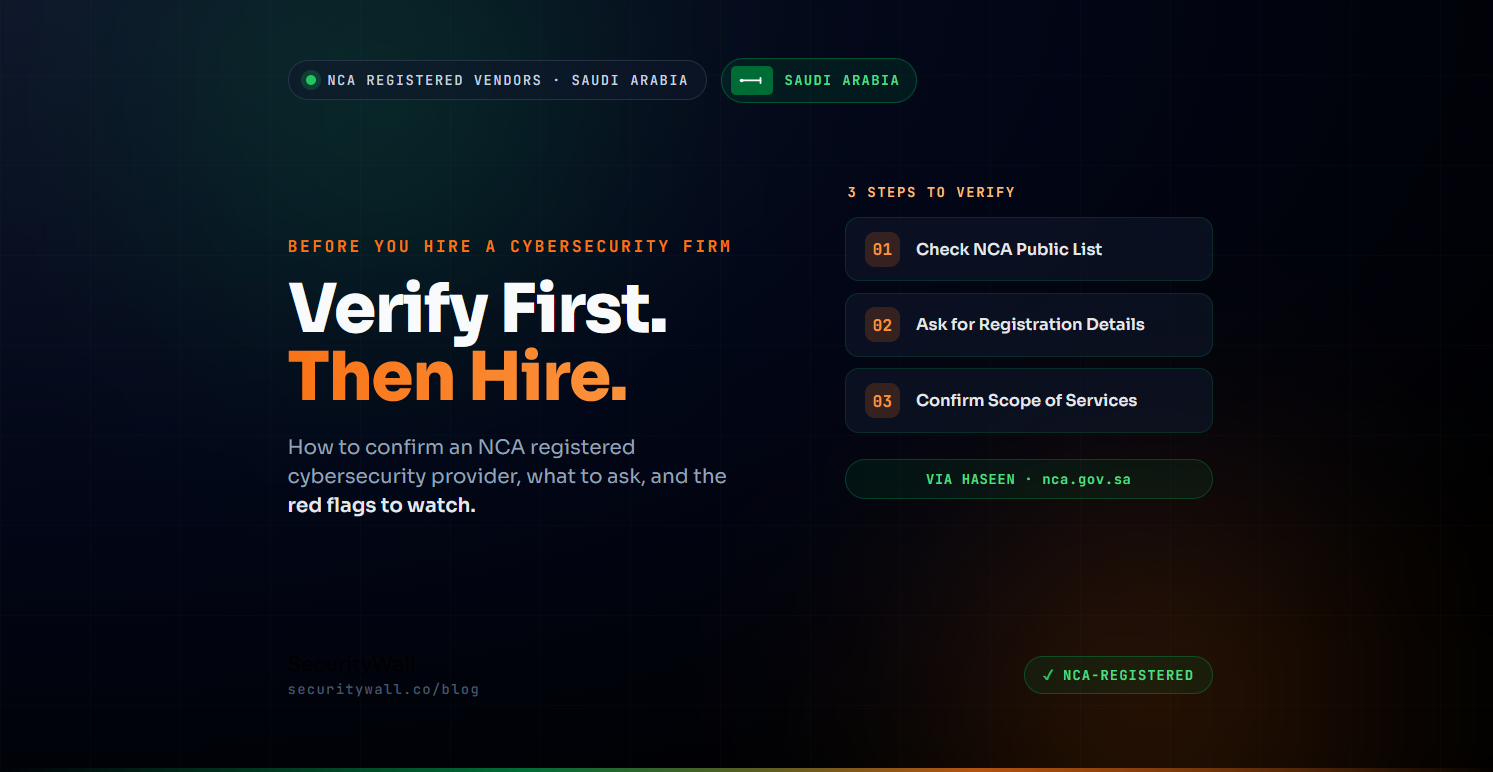
You are about to hire a cybersecurity firm to work in Saudi Arabia. Maybe for a gap assessment, a penetration test, implementation support, or a managed service. You have a shortlist of vendors, glossy pitch decks, and a few who claim to be "NCA-aligned" or "NCA-compliant." Before signing anything, you need a way to confirm independently and quickly that the company you are about to engage is actually permitted to provide cybersecurity services in the Kingdom.
This is the article that walks you through that verification, It explains what NCA registration actually means, why it matters for your own compliance position, how to use the NCA's own public mechanisms to verify a provider, the questions you should ask before hiring, the red flags to watch for, and the subtle but important distinction between general registration and the NCA's separate MSOC licensing programme.
Throughout, the goal is operational utility not a vendor pitch. If you bookmark one section for your procurement process, make it the step-by-step verification below. For the broader regulatory context, see our guide to what the NCA is.
- What NCA Registration Means for Cybersecurity Providers
- Why Buying From an NCA Registered Provider Matters
- How to Verify a Cybersecurity Company Is NCA Registered
- What to Ask Before Hiring
- Red Flags to Watch For
- Registration vs Licensing — A Subtle Distinction
- SecurityWall — Our Registration Status
What NCA Registration Means for Cybersecurity Providers
On 25 April 2022, the National Cybersecurity Authority launched an online platform for registering cybersecurity service, solution, and product providers operating in the Kingdom. From 1 August 2022, registration on the NCA's digital platform became a regulatory requirement for any entity providing cybersecurity services, solutions, or products in Saudi Arabia. This is documented on the NCA's own Registration and Licensing page.
Registration is processed through the National Cybersecurity Services Portal Haseen, which the NCA describes as the central national platform for the cybersecurity services ecosystem. Providers submit their application through Haseen; once registered, they appear on the NCA's official public list. Registration covers the broad cybersecurity services market consultancy, assessments, penetration testing, implementation, training, products, and most other commercial cybersecurity offerings provided in the Kingdom.
Two things follow from this that buyers often miss. First, registration is regulatory, not marketing: it is the legal pre-condition for operating as a cybersecurity provider in Saudi Arabia, not a quality badge a firm chooses to pursue. Second, the NCA publishes a public list of registered service providers, which means you do not have to take a vendor's word for their status you can verify it yourself.
Why Buying From an NCA Registered Provider Matters
There are three reasons this matters more than buyers realise.
Your own compliance position. When you go through an NCA assessment under the Essential Cybersecurity Controls or NCNICC-1:2025, assessors look at how you manage third parties and the security work commissioned from them. Engaging a cybersecurity provider that is not registered with the NCA is precisely the kind of supplier-management gap your assessment will flag. It is an own-goal: you commissioned the assessment to find gaps, and the very act of doing so created one.
Defensibility of the work product. A penetration test report, a gap assessment, a remediation plan these are documents you may need to present to auditors, regulators, customers, or partners. A report produced by an NCA-registered firm is defensible; a report produced by an unregistered firm raises questions that take time and energy you do not have.
Contractual and procurement reality. Many Saudi government, CNI, and enterprise procurement processes now require evidence that suppliers and sub-contractors providing cybersecurity work are NCA-registered. Discovering mid-tender that your shortlisted provider does not meet this requirement disqualifies the proposal sometimes the entire bid.
The cheapest mistake to avoid is hiring an unregistered provider and finding out, late, what that costs.
How to Verify a Cybersecurity Company Is NCA Registered
This is the section to bookmark. The verification flow has three steps and takes about five minutes if you have a vendor name in front of you.
Check the NCA's Official Public List
The NCA publishes a public List of Registered Service Providers on its own website. This is the single most authoritative way to confirm a provider's status:
- Open the NCA's List of Registered Entities
- Search for the provider's name
- Confirm they appear on the list and note their listed scope
If they are not on the list, they are not NCA-registered regardless of what their marketing says. A provider claiming to be "NCA-registered" without appearing on this list is, at best, mis-stating their position.
SecurityWall is one of Top Registered Cybersecurity Audit at NCA
What to Ask Before Hiring
Beyond registration, a small number of questions separate a credible cybersecurity provider from a polished pitch. The questions to put in your RFI, RFP, or first call:
- "Can you confirm your NCA registration details and the scope it covers?" If they are registered, they will tell you. If they hedge, you have your answer.
- "What are the team certifications of the consultants and testers who will actually be on this engagement?" Look for OSCP, OSWE, CREST, CRT, CISM, CISSP, and other recognised offensive and governance credentials held by the people doing the work, not just the firm's bench-warmers.
- "Can we see a redacted sample of the report we will receive?" A credible firm has reports they can show you (redacted). A vague answer here usually means the deliverable will be boilerplate.
- "What methodology do you follow, and is your work mapped to ECC 2:2024 / NCNICC-1:2025 / SAMA / PDPL where relevant?" The right answer is specific. The wrong answer is "industry best practice" with no detail.
- "Who is the day-to-day engagement lead, and what is their availability?" Sales pitches feature senior partners; engagements often get junior consultants. Get the name of the person who will run yours.
- "What does retesting and remediation look after a finding?" A credible firm includes verification of fixes; a less credible one hands you a PDF and disappears.
- "Can you give two references from clients in similar circumstances we can speak to?" Saudi-based clients in your sector are the strongest signal. Do ask for references and verify them. New registered firms are not familiar with the NCA Compliance usually.
Print this list and use it. Procurement teams that ask these questions hire better and pay less.
Red Flags to Watch For
A few patterns reliably indicate trouble.
- Without registration. The actual is registered with the NCA, which is binary and verifiable. If a provider uses the soft language without the hard registration, ask why.
- No named certified consultants. The firm-level credential is the bench; the individual-level credentials are who actually does the work. A provider that cannot name the certified people on your engagement is a provider whose engagement will be staffed by whoever is free.
- Boilerplate scope and pricing. A penetration test or gap assessment scoped without a discovery call, priced identically across very different clients, is a product not a service.
- Vague reporting. "We provide a comprehensive report" is not a deliverable. Ask to see one.
- Reluctance to share registration details. A registered provider will share their registration on request. Deflection or delay is information.
None of these alone is fatal. Two or more together usually is.
Registration vs Licensing — A Subtle Distinction
There is a distinction most buyers and many vendors overlook. The NCA operates two related but separate mechanisms:
- Registration, which has been a regulatory requirement since 1 August 2022 for any entity providing cybersecurity services, solutions, or products in the Kingdom. This covers the broad cybersecurity services market.
- Licensing, which applies to specific higher-tier services most notably Managed Security Operations Center (MSOC) services. The NCA opened MSOC Tier 1 licensing applications in August 2024 (the Tier 1 window closed in October 2024), and Tier 2 MSOC licensing applications remain open through the Haseen portal.
The practical implication: a provider can be NCA-registered to provide consultancy, assessments, or penetration testing, but not licensed to deliver MSOC services. If you are commissioning a managed SOC, ask specifically about MSOC licensing in addition to registration they are not the same thing. Most providers in the market are registered; far fewer are MSOC-licensed.
For buyers commissioning advisory and offensive security work the bulk of the market registration is the relevant credential. For buyers commissioning a managed SOC, both registration and Tier 1/2 MSOC licensing are in play.
SecurityWall — Our Registration Status
SecurityWall is an NCA-registered cybersecurity firm providing services across Saudi Arabia. We registered through the Haseen portal in line with the NCA's regulatory requirement for cybersecurity service providers operating in the Kingdom. Our team holds OSCP, OSWE, CREST, CRT, CISM, and CISSP credentials, and our work spans consultancy, gap assessments, penetration testing, NCA compliance, and the dual-compliance work that arises when SAMA and PDPL stack on top of NCA frameworks.
What our registration covers, in practice:
- NCA compliance work scoping, gap assessments, implementation support, and audit-readiness across ECC 2:2024 and NCNICC-1:2025
- Offensive security penetration testing, red teaming, and mobile application testing scoped to the NCA's Defence-domain requirements
- Dual compliance for financial institutions programmes that satisfy both the NCA and SAMA, including the fintech and BNPL stack
- PDPL technical safeguards the cybersecurity side of PDPL compliance, built alongside legal and DPO functions
- Sector-specific support startups, AI companies, SaaS, and other regulated verticals
Related reading:
- NCA ECC 2:2024 Requirements: Every Control Domain Explained
- NCA ECC Compliance Checklist (Interactive)
- NCA Gap Assessment: What to Expect and How to Prepare
- NCA Penetration Testing Requirements in Saudi Arabia
- NCA and SAMA Dual Compliance for Banks and Fintech
- PDPL Saudi Arabia 2026: The Full Compliance Guide
- What Is the NCA? Saudi Arabia's Cybersecurity Authority
- SecurityWall - Top NCA Registered Cybersecurity Audit Firm
Frequently Asked Questions
What does NCA registration mean for a cybersecurity company?
NCA registration is the regulatory requirement that any entity providing cybersecurity services, solutions, or products in Saudi Arabia must be registered with the National Cybersecurity Authority. The requirement has been in force since 1 August 2022. Registration is processed through the National Cybersecurity Services Portal (Haseen), and registered providers appear on the NCA's public list of registered service providers.
How do I verify if a cybersecurity company is NCA registered?
Check the NCA's official List of Registered Service Providers at nca.gov.sa/en/registration-and-licensing/entity-list/, ask the provider directly for their registration details, and confirm the scope of registration covers the services you are commissioning.
Why does it matter that my cybersecurity provider is NCA registered?
Because using an unregistered provider is itself a supplier-management gap that NCA assessors look at, because work products from unregistered providers are harder to defend in audit and procurement, and because many Saudi government, CNI, and enterprise procurement processes now require evidence of supplier NCA registration.
Is NCA registration the same as NCA licensing?
No. Registration applies broadly to any cybersecurity service, solution, or product provider in the Kingdom. Licensing applies to specific higher-tier services notably Managed Security Operations Center (MSOC) services, where the NCA operates Tier 1 and Tier 2 licensing through the Haseen portal. A provider can be registered but not MSOC-licensed.
What questions should I ask before hiring a cybersecurity company in Saudi Arabia?
Confirm their NCA registration details and scope, the certifications held by the consultants who will actually do your engagement, redacted sample reports, methodology and framework alignment (ECC 2:2024, NCNICC, SAMA, PDPL where relevant), the named engagement lead and availability, retesting and remediation approach, and two Saudi references in similar circumstances.
Is "NCA-aligned" the same as NCA-registered?
No. "NCA-aligned" or "NCA-compliant" are marketing descriptions providers use to suggest their work meets NCA expectations. NCA-registered is the binary, verifiable regulatory status. A provider should be registered if they operate in the Kingdom alignment alone is not a substitute.
Where can I find a list of NCA registered cybersecurity companies?
The NCA publishes a public List of Registered Service Providers on its website at nca.gov.sa/en/registration-and-licensing/entity-list/. This is the authoritative source. SecurityWall is one of Top Registered NCA Company with certified staff and already proven experience in Saudi Arabia.